

Welcome to The Desk in the Lantern Room. Today, we are looking at some fiction that rolled off the Typewriter several years back. Having given several eulogies or funeral speeches over the last decade, I decided I’d like to try my hand at writing one for a fictional character. So let’s dive in and learn about Sam and all his bikes.
Eulogy
I got to know Sam’s house before I really got to know Sam, or, should I say, Sam’s house was the reason I felt like I knew him before we ever uttered a word to each other. It was small, and the yard was even smaller, but somehow, he managed to fit more stuff on that lot than I could find a place for on mine, which is about twice the size. There was a small shed, a trailer that was at least half home-built, various garden beds and trellises (again home-built), and bikes. Sam had every manner of bike you could imagine. He had old bikes, new bikes, kid bikes, adult bikes, tandem bikes; he even had one road bike painted white, wrapped in Christmas lights with its handlebars turned upwards like antlers and a round red nose stuck right in the middle.
What I noticed the most, though, were the kid bikes. It seemed like there was a constant rotation of them in the yard. Every once in a while, one would show up that I could have sworn I had seen the year prior in the same spot, but one thing was for certain: I did see most of those bikes cruising around the neighborhood or lying unattended on the sidewalk at some point or another. Some of them could be seen racing cars, but from the sidewalk, or going over rickety jumps made out of boards. If Sam saw this on one of his walks, he would simply shake his head with disapproval and keep walking. There was nothing he could do about it; it just meant that the bike would probably be back in his yard for a tune-up sooner rather than later.
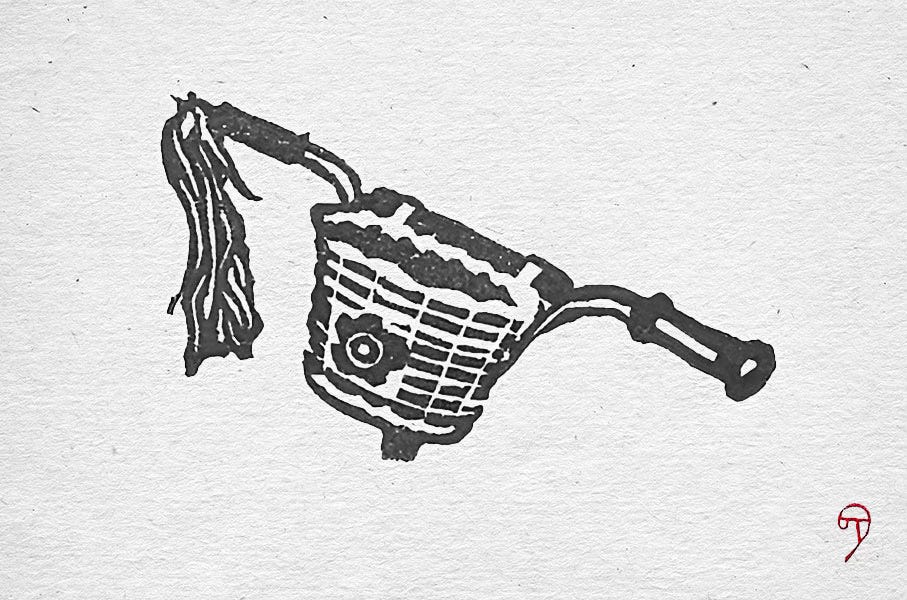
One day, a young girl rode a bright pink bike by our house. It had white plastic tassels hanging from the ends of the handlebars and a bell. It also looked about a size too small for the girl on top of it. I asked my daughter, Katelyn, if she liked that bike. She said yes, and I said that if we played our cards right, I bet it could be hers for a time. You see, it had become clear to me that more than half of the bicycles I saw in about a four-block radius had been underneath multiple different children at one point or another and made visits to Sam and Darla’s yard at least once per season.
A year later, in early June, shortly after Katelyn turned five, she was scooting around on one of those balance bikes with no pedals when Sam walked purposefully up to our house, pink bike in tow, now with training wheels attached. Our time had come.
Now, shamefully, I hadn’t spoken a word to Sam or Darla up until this point. I knew he worked with his hands, had a lot of irons in the fire, and was the neighborhood bike guy. That was it. In fact, I didn’t even know his name until that day.
So Sam comes walking along, greying hair pulled back into a low ponytail and mustache, evoking that of David Crosby. It’s warm out, so he’s got one of his short-sleeved button-downs on—this time a checked blue and white pattern—and khaki shorts. I met him where the sidewalk to our house hit the one that ran parallel to the road. We introduced ourselves, and I waved Katelyn over. I told her that her turn had come. Sam asked if he was that predictable, and I said yes. He laughed a soft sort of laugh that barely made it past his considerable mustache. His eyes twinkled, but when I looked at those eyes, I saw something between the twinkle and the wrinkled crow’s feet that seemed somber, maybe even sad. It was fleeting, and I forgot it almost as quickly. It wasn’t until almost twenty years later, in the years leading up to Darla’s death, that I remembered it.
Sam bequeathed the bike to us, and I soon had Katelyn riding it. She was a notoriously slow grower—short, like me—and managed to get two whole summers out of the thing. The second year, the training wheels came off, and I hung on to them until I saw Sam walking down the alley with another bike one day and returned them to him. He asked if the pink bike needed a tune-up, but I said no: Katelyn was a gentle rider (no jumps), and it was still in perfect working order. He smiled, eyes twinkling like Santa Claus, and continued on his walk. It was silly, really; Sam lived less than half a block away, and rather than stopping by his house myself, I sat here waiting for him to show up with the pink bike and then waiting for him to come by again for the opportunity to give him the training wheels.
Our relationship continued like this for many years. Both Katelyn and my son, Art, benefited from Sam’s neighborhood bike swap for most of their childhood. Katelyn got her first ten-speed from Sam, but by the time Art was ready for some gears, he was all out of stock. That was the only bike we paid money for before getting into the adult bike sizes.
Fast forward to 2017. That fall, my wife passed away. It was highly unexpected. Both Kate and Art had moved out by then, and the already empty nest became a desolation. Sam noticed the sudden burst of activity at our house and knew what had happened, but bided his time. He waited until my family, friends, and children had moved on with their lives before making it his mission to become part of mine.
I was in the backyard a few weeks later when I saw Sam come around the corner of the neighbor’s fence as he walked down the alley. His hair was stark white by this time. I waved, he waved back, and, to my surprise, immediately turned right into our yard. He walked straight toward me, and I noticed he had two brown bottles of beer in his left hand. He gave me a handshake with his other hand and then offered me a beer. He said, “I thought you might need a bike.” I looked down. The beer was a Fat Tire.
Sam comforted me through my loss like nobody else in my life. All of my friends, acquaintances, and family—no one kept at me like Sam. It was surprising, and yet I still didn’t pursue a relationship with him, that is, beyond what we already had. He ambled by once a week, sometimes every other—beers with bikes on them in hand—and we would talk. This is when I began to know Sam beyond what I saw from the street. I also began to learn that there was something else, something big, underlying his entire being that I did not know. That touch of sadness started to peek through the sparkle in his eyes more and more often during our conversations. I suspected it may have had something to do with the fact that most of the neighborhood kids had grown up and moved away, while most of the parents had remained. So, for the first time, maybe ever, the neighborhood was growing old with him. I thought that was part of it, but it wasn’t.
Then, one night, after a few ‘bikes,’ he made an offhand reference to Vietnam, which I soon found out was a mistake. I prodded him on the subject, but he was unwilling to talk about it. I thought that I had now found my answer, that it was just the unspeakable horrors of war that plagued him, but it took another couple of years for me to learn that while that was most of it, it was not all.
When Sam’s wife, Darla, died, it was my turn. I was there for the funeral, of course—my kids even came to town for it—but after that, I waited. Sam stopped coming by for our almost-weekly chats, but that was ok. I kept a close eye on his house, and when the signs of life started to clear up, I bought a six-pack of ‘bikes.’
That night, the first night I walked over to Sam’s house myself, I brought two ‘bikes’ with me. He was in the backyard in a folding chair. There was another next to it, and I don’t know if it was there because he was expecting me or if it was for Darla out of habit. I walked up, asked if he wanted a ‘bike’ with a smile on my face, and quickly realized that he needed a bike just about as much as he needed one at any other point in his life.
Sam was drunk.
That was the night that I finally, truly knew Sam. He did take the beer, even though I hesitated to give it, and within half an hour, I had returned home for the other four and brought them over for myself. Sam and I talked about a lot of things that night. We talked about his depression, mostly. I would have never thought he was depressed. All those nights we spent talking in the backyard or the garage or the front porch, and I never knew. I saw the sadness, but never depression. He kept it hidden deep behind the mustache and the twinkle.
I also learned about his drinking problem. Sam wasn’t really an alcoholic, but when the depression got the better of him, so did the drink. It was never enough to affect his life outwardly, but it was there. The days since the last family member left town had been one of his worst benders, he said, and I regretted not going over sooner. That was, I regretted it until the end of the night when something happened that I don’t think could have happened on any other night; it was destined for that moment.
The sun was going down, and a chill was on the air. I was in a t-shirt and shorts, warmed by five beers, but once the chill set in, it didn’t let go. So I put my empties back in the six-pack box and stood to walk home. I noticed the pink bike that my daughter once rode, now somewhat rusted and white tassels yellowing, leaning against the back of his shed. I don’t know how I didn’t see it before that moment, but again, everything that happened that night felt more predestined than anything else in my life.
I saw the bike, and I turned to Sam. He was still in his chair, gazing at something beyond me but not seeing it. I decided that now was the time to ask him the question that had been on the edge of my mind for over two decades.
“Sam,” I said, “Why the bikes? Why for the kids? I know you enjoy it, but to do it for as long as you have…why?”
Sam kept staring, and just as I thought he wasn’t going to answer, he looked me in the eye and said, “I killed a kid.”
I looked back at Sam with blank confusion, a little incredulity, and, I think, probably some revulsion. I thought about sitting back down, but something about that didn’t seem right, so I remained where I was, standing on the edge of the alley, he in his folding chair. Then he continued.
“Back in ‘Nam. Tracked a band of Vietcong through the jungle to a village; nasty stuff. We were positive it was abandoned, families already gone, driven out by the war. Had a perimeter around the place. I was looking through my sights at a hut that had this mound of dirt next to it that obscured its doorway. Suddenly, a face popped over the dirt. It didn’t creep out; it just shot up, and I…well…I shot, too. A firefight erupted.
“Once we were certain we had cleared the place, we moved in, and I made straight for that pile of dirt and mud because something was nagging at me, something didn’t look right about that face. I walked around the edge and saw two small feet, and my gut sank into my toes. I could barely make myself do it, but I kept going, I had to be sure.”
Sam dropped his head at this point and looked at the weathered hands in his lap, the ones that had shot a child and provided bikes to many more. I thought he might be crying, but when he looked back up, his eyes were clear. “He looked to be about eight or nine years old. I cried myself to sleep that night and many more times since.”
Sam stopped then. That was the end of the story that I don’t believe he ever wanted to tell.
“So that’s why?” I asked.
“That’s why,” Sam replied.
I remember nodding at him and smiling. “You’ve done good, Sam,” I said.
“I hope so,” was all he said in return, and when he smiled back at me, the crow’s feet, the twinkle, and the sadness were all still there.
Wow! This is heart wrenching and heartwarming all at the same time.
I was not prepared for this today, Andrew...
You know, I read this, hearing you reading it, which was perfect. What a bloody good writer you are, man.